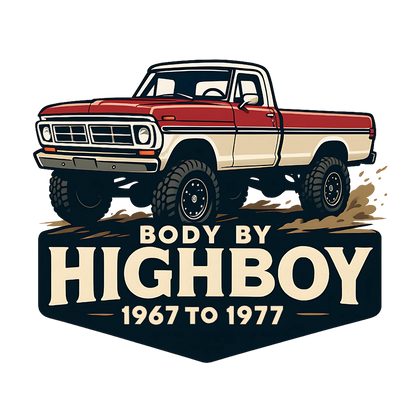

A Ford Highboy is the four-wheel-drive F-250 that Ford built from 1967 through the middle of 1977. What sets it apart is a divorced transfer case — one mounted to the frame instead of bolted directly to the transmission — which raised the front end and gave the Highboy its tall, unmistakable stance. “Highboy” was never an official Ford name; it’s a nickname coined by owners, and it has stuck ever since.
If you’ve spent any time around vintage Fords, you’ve probably heard the word thrown around loosely to mean “old lifted Ford truck.” But a true Highboy is a specific machine. Here’s what actually makes one.

What makes a Ford Highboy a Highboy
The heart of the Highboy is its divorced transfer case. On most 4x4s, the transfer case bolts directly to the back of the transmission. Ford’s early F-250 4x4s were built from two-wheel-drive chassis, so rather than engineer an adapter, they connected the transfer case — a Dana 24, NP203, or NP205 depending on the year — to the transmission with a short driveshaft. That “divorced” setup pushed the front end up, which is what gives a Highboy its height.
To level the stance back out, Ford added 4-inch lift blocks in the rear. The result was a truck that sat noticeably taller than a regular F-250 — roughly two to three inches over its 2WD siblings — without any aftermarket lift. Contrary to a common myth, the front isn’t “factory lifted”; it simply rides high because of that divorced case.
A few other tells of a genuine Highboy:
- Frame width: narrow rear frame rails about 33.5 inches apart — the same as an F-350.
- Stance: sits roughly 2–3 inches taller than a standard F-250 of the same year.
- Model: always an F-250 4x4 — never an F-100.
- Years: 1967 through the middle of 1977.
Highboy vs. Lowboy
Midway through the 1977 model year, Ford switched to a married transfer case — bolted directly to the transmission, like a modern 4x4. That change dropped the front end, made the rear lift blocks unnecessary, and lowered the whole truck. Enthusiasts started calling these later trucks “Lowboys.” So the quick rule of thumb: 1967 to mid-1977 divorced-case F-250 4x4s are Highboys, and mid-1977 through 1979 married-case trucks are Lowboys. 1977 is the only year you truly have to check, because both were built that year.
Where “Bumpside” and “Dentside” fit in
Highboy describes the drivetrain and stance. Bumpside and Dentside describe the body style, and they cover the whole F-100 through F-350 lineup, 2WD or 4WD:
- Bumpside (1967–1972) — named for the raised body line that runs down the side of the bed.
- Dentside (1973–1979) — named for the indented crease along the body.
That’s why you’ll hear a truck called both at once. A “Bumpside Highboy” is simply a 1967–1972 F-250 4x4 with the divorced transfer case; a “Dentside Highboy” is the 1973 to mid-1977 version.
Not sure which year you’re looking at? The grille is the fastest tell — our Ford Highboy grille guide walks every front end, year by year, from 1967 to 1977.
Why Highboys still turn heads
Part of it is the look — that tall, purposeful stance is unmistakable, and you can tuck 38-inch tires underneath a Highboy with little to no suspension work. Part of it is the toughness: simple FE and 385-series V8s, gear-driven transfer cases, and a frame that shrugs off abuse. And part of it is history — the original Bigfoot, the truck that launched the entire monster-truck world, started life as a Ford Highboy.
One last bit of trivia: the “Highboy” nickname wasn’t born on a truck at all. It originally described 1928–1932 Ford roadsters that sat tall on their frames. Somewhere along the way, Ford truck people borrowed it — and it fit the F-250 4x4 perfectly.
Own a piece of it
Whether you’re running a Bumpside, a Dentside, or a genuine divorced-case Highboy, these trucks earn every bit of the loyalty they get. If you want to fly the flag, our Bumpside and Dentside apparel is built for exactly that — designed by people who love these old Fords as much as you do.
Keep the old Ford story going
Shop all Body By Highboy gear, or choose a year’s front end from the Grille Series.
Visit Highboy University for truck guides. Read Bumpside vs. Dentside: Ford Truck Generations Explained, then meet the people behind Harry’s 1977 Ford: From a Cheap Challenge to Alaska.
Your truck belongs in this community, too. Share your truck story and photos.


